Newsletter Subscribe
Enter your email address below and subscribe to our newsletter

 ByJohn A
Syllabus shock is a very real phenomenon for computer science undergraduates across the United States. In introductory programming courses, code feels linear, predictable, and manageable. However, the moment a curriculum transitions into system-level engineering, object-oriented architecture, and manual memory manipulation, the learning curve turns completely vertical. Managing hardware resources demands a flawless understanding of where data lives, how long it stays there, and who is responsible for cleaning it up. When complex data structures overlap with grueling examination schedules and part-time internships, maintaining a competitive GPA becomes an overwhelming balancing act. It is precisely during these high-stress weeks that finding an elite developer to help do my assignment in USA tech programs transitions from a simple shortcut to a vital time-management strategy for students trying to protect their academic standing.
To survive and thrive in modern programming, you must move past ancient, error-prone manual memory habits. In the professional world, explicit calls to legacy allocation tools like new and delete are heavily discouraged. Instead, modern software development relies on automated resource management rules. This beginner-friendly guide will demystify how pointers operate under the hood, break down the core mechanics of exception safety, and show you exactly how to write clean, leak-free code that passes both university grading scripts and enterprise-level code reviews.
In legacy programming workflows, a raw pointer is simply a variable that stores the direct hardware address of another value in memory. When you request space on the system heap using a traditional statement, the operating system reserves that block of memory and hands you the keys. The massive catch? The system expects you to manually hand those keys back using an explicit delete statement the exact moment your code is done with that data.
This manual workflow introduces critical vulnerabilities into software projects:
The ultimate failure of manual allocation happens during runtime errors. If an unexpected exception occurs or a function exits early through an automated return statement midway through your execution path, your manual cleanup code is skipped entirely. That allocated memory is stranded forever, crashing your program and instantly failing your assignments.
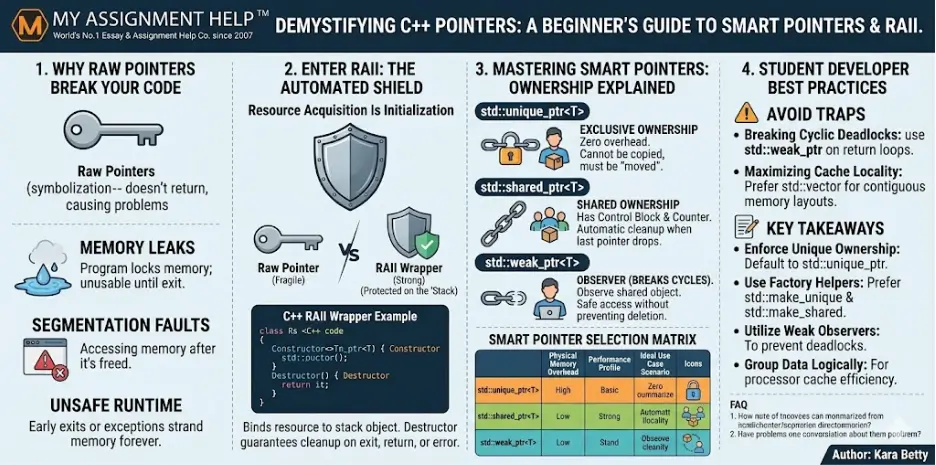
Modern development solves these structural weaknesses through a rule called RAII (Resource Acquisition Is Initialization). Instead of managing raw hardware resources out in the open, RAII binds the lifecycle of a heap allocation directly to the lifetime of a standard, stack-allocated wrapper object.
The stack is a highly structured, ultra-fast region of memory managed entirely by the compiler. When a function executes, its local stack variables are created automatically; the exact millisecond that function finishes or hits an error, the compiler unwinds the stack frame and clears those variables out in reverse order. By placing a raw resource inside a stack-wrapped object, we can exploit this automated behavior to build an armor-plated cleanup system.
C++
// A Simple RAII Wrapper demonstrating automated heap cleanup
#include <iostream>
#include <stdexcept>
template <typename T>
class SmartContainer {
private:
T* m_raw_ptr; // The actual data address hidden inside the wrapper
public:
// 1. Acquire the resource during initialization (Constructor)
explicit SmartContainer(T* resource) : m_raw_ptr(resource) {
if (!m_raw_ptr) {
throw std::invalid_argument(“Invalid memory allocation request.”);
}
}
// 2. Automatically release the resource when dropped (Destructor)
~SmartContainer() {
delete m_raw_ptr;
std::cout << “Memory safely reclaimed by the system!\n”;
}
// Disable dangerous duplication copying to protect the resource
SmartContainer(const SmartContainer&) = delete;
SmartContainer& operator=(const SmartContainer&) = delete;
// Provide safe, direct access to the underlying data
T& get() const { return *m_raw_ptr; }
};
When an instance of our wrapper is built, its constructor instantly claims ownership of the raw data. The moment the local stack frame ends—whether through a normal exit, an early return statement, or a runtime exception throw—the language runtime guarantees that the wrapper’s destructor fires. The destructor safely frees the wrapped heap data, establishing perfect immunity to memory leaks.
You do not need to build custom wrappers from scratch for every assignment. The standard library provides built-in RAII utilities known collectively as Smart Pointers. To maximize application performance and write clean code, you must choose the correct smart pointer based on clear ownership rules.
A std::unique_ptr maintains a strict, one-to-one relationship with its referenced asset. It owns the resource exclusively, meaning no other pointer in your program can lay claim to that exact same address space.
Because it tracks zero supplementary internal data, its compiled footprint is exactly equal to a raw memory pointer ($Size = 1 \times sizeof(void*)$), introducing absolutely zero runtime speed penalties. It cannot be duplicated through standard copying; instead, if you need to pass it to a new function, ownership must be transferred using move semantics via std::move().
When multiple independent systems require simultaneous access to a single shared asset, a std::unique_ptr is too restrictive. In these scenarios, a std::shared_ptr provides non-exclusive ownership tracking through a hidden helper block known as the Control Block.
This control block is dynamically allocated on the heap and stores a primary reference counter. Every time a new std::shared_ptr variable binds to the asset, the counter increments. When a pointer variable drops out of scope, the counter decreases. The moment that primary counter hits zero, the underlying asset is automatically scrubbed from memory.
However, this convenience brings measurable hardware costs:
When self-study isn’t enough to grasp these complex pointer lifecycles, turning to structured code reviews or dedicated c++ homework help services can bridge the gap between academic theory and production-grade software. Working with an expert helps you visualize these background memory trade-offs, master reference counters, and ensure your code submissions meet rigorous industry efficiency standards.
The following architecture layout details the structural footprint and primary usage models for modern smart wrappers:
| Pointer Choice | Physical Memory Overhead | Performance Profile | Ideal Use Case Scenario |
| std::unique_ptr<T> | 0 Bytes (Equal to raw pointer) | Exceptionally fast; zero runtime slowdowns | Your absolute default choice; perfect for factory systems and local function objects. |
| std::shared_ptr<T> | Double pointer size + Control Block allocation | Slower due to atomic counter synchronization | Use only when multiple decoupled systems must share an asset with unpredictable lifecycles. |
| std::weak_ptr<T> | Tracks Control Block without protecting asset | Fast; requires temporary conversion to access | Observes shared pointers safely without preventing deletion; essential for breaking cyclic locks. |
Even with modern smart pointers at your disposal, architectural mistakes can still trigger bugs and slow your programs down. Beginners must keep a watchful eye out for cyclic references and unorganized memory layouts.
A cyclic dependency occurs when two distinct std::shared_ptr instances contain internal pointers that point directly to each other (e.g., a parent node holding a shared pointer to a child node, while the child simultaneously holds a shared pointer back to the parent).
Because each object holds an active ownership claim on the other, neither primary reference counter can ever drop to zero. Both objects become permanently locked in a stalemate, triggering a massive memory leak despite using smart wrappers.
To break this loop, change one of the connection paths to a non-owning std::weak_ptr. Weak pointers can observe a control block but lack the authority to increment the primary counter. Before accessing the underlying resource, the weak pointer must temporarily elevate itself to a full shared pointer by invoking the .lock() method, ensuring safe access even if another thread cleared the asset earlier.
Modern computer processors load data into ultra-fast cache memories using fixed 64-byte chunks known as Cache Lines. If your program scatters its data objects across random, non-contiguous heap regions, the processor must constantly pause execution to fetch updates from the slow main system memory.
To keep your code performing at maximum speed, arrange your sequential data structures inside contiguous memory layouts like std::vector. This allows the hardware prefetcher to load adjacent data elements into the cache before your execution thread even requests them, maximizing your processing efficiency.
Key Takeaways for Student Developers
See also: The Rise of NFTs in the Crypto Industry
Q1: Can I safely store a std::unique_ptr inside standard containers like a vector?
Yes, absolutely. Standard library containers support move semantics natively. While you cannot copy a unique pointer into a vector, you can transfer ownership into the container using std::move() or allocate elements directly inside the vector using emplace_back().
Q2: Why is using std::make_shared preferred over initializing a shared pointer manually?
Using std::make_shared combines both your data object and its tracking control block into a single, contiguous heap allocation. This cuts your allocation overhead in half and dramatically improves cache performance compared to running two separate allocations.
Q3: What is a dangling pointer, and do smart pointers eliminate them completely?
A dangling pointer points to a memory address that has already been cleared by the system. Smart pointers eliminate this issue for heap assets by automatically ensuring that an object stays alive as long as an active owning smart pointer references it.
Kara Betty is a Senior STEM Academic Consultant and technical content writer at MyAssignmentHelp, guiding computer science and engineering students across the United States through systems programming architectures, object-oriented design patterns, and compiler optimization strategies.